

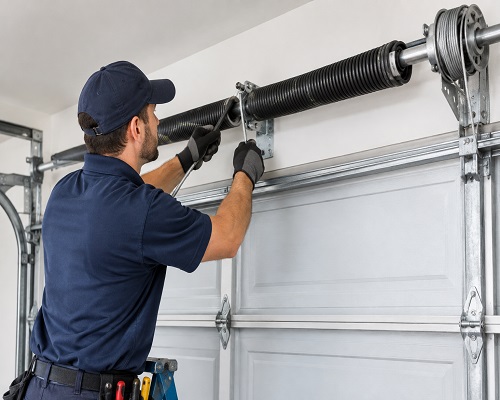
One of the first questions homeowners ask is: How much does garage door spring replacement cost?
In 2026, homeowners commonly pay around $150 to $350 for professional garage door spring replacement, although the final price can be higher or lower depending on the type of spring, garage door size, number of springs, labor, and other repairs that may be needed.
Because every garage door is different, the best way to know the exact cost is to have the spring system inspected by a professional.
Garage door springs are an important part of the door's lifting system.
A garage door can be very heavy, so the springs help support the weight and make it possible for the door to open and close smoothly.
There are two common types of garage door springs:
Both systems are designed to help balance the garage door, but they work in different ways and have different installation requirements.
When a spring breaks or becomes worn, the garage door may become difficult or impossible to operate.
The cost of replacing a garage door spring depends on the type of spring and the specific door.
As a general 2026 estimate:
| Garage Door Service | Typical Cost Range |
|---|---|
| Torsion spring replacement | $150–$350 |
| Extension spring replacement | $120–$200 |
| Spring and cable replacement | $200–$500 |
| Torsion spring system conversion | $400–$800+ |
These are general ranges, not guaranteed quotes. Local labor rates, door size, spring specifications, emergency service, and additional repairs can change the final price.
For example, current cost guides place professional replacement for a single garage door commonly around $150–$350, while replacing springs on two doors can cost more because of the additional parts and labor.
Several factors can change the price of a garage door spring replacement.
The type of spring is one of the biggest factors.
Torsion springs are installed above the garage door and work by twisting around a shaft.
Extension springs are normally installed along the sides of the garage door and stretch as the door moves.
Extension springs generally cost less to replace, while torsion spring systems can have higher replacement costs depending on the door and spring specifications.
A heavier garage door requires springs that are properly sized for the door.
For example, a large insulated double garage door may require stronger or multiple springs compared with a smaller single-car garage door.
The correct spring must be selected based on the door's specifications and weight.
Installing the wrong spring can affect the balance and operation of the entire garage door system.
Some garage doors use one spring, while others use two or more springs.
If more than one spring is worn or broken, replacing the complete spring setup can increase the total cost.
When one spring fails on a two-spring system, a technician may recommend replacing both springs so the door remains properly balanced.
Professional garage door spring replacement includes more than simply installing a new spring.
A technician may need to:
Labor rates vary by location and company.
Sometimes the spring is not the only damaged component.
A broken spring may be accompanied by problems with:
If additional parts need repair or replacement, the total cost will increase.
A broken spring can leave your garage door stuck.
If you need service outside normal business hours, emergency or same-day service may cost more than a scheduled appointment.
The exact additional charge depends on the company and the time of service.
Understanding the difference between the two main spring systems can help homeowners understand their repair options.
Torsion springs are mounted above the garage door opening.
They store energy by twisting and help control the movement of the garage door.
Torsion springs are commonly used on sectional garage doors.
A torsion spring replacement may cost approximately $150–$350, depending on the system and labor.
Extension springs are typically installed along the sides of the garage door.
They stretch and contract as the garage door opens and closes.
Extension spring replacement can commonly fall around $120–$200, although prices vary by door and service requirements.
A professional should determine which spring system your garage door uses before replacement.
A garage door spring usually gives warning signs before or when it fails.
Here are some common signs to watch for.
If you press the opener and the motor runs but the door does not lift, a broken spring could be one possible cause.
Do not assume the opener is the problem until the complete system has been inspected.
If you normally can lift the garage door manually but it suddenly feels extremely heavy, the spring system may not be supporting the door correctly.
A broken garage door spring can make a loud popping or snapping sound when it breaks.
You may not immediately see the problem, but the door may stop working afterward.
A door that becomes crooked or moves unevenly may have a spring, cable, track, or balance problem.
If the garage door falls or does not stay in position when manually opened, the spring system may need inspection.
With some torsion spring systems, a visible gap in the coil can indicate that the spring has broken.
Do not touch the spring or attempt to adjust it.
Garage door springs do not last forever.
Their lifespan is usually measured in cycles, with one cycle meaning one complete opening and closing of the garage door.
Many standard springs are designed for approximately 10,000 to 20,000 cycles, which can translate to roughly 7 to 14 years for many residential applications. Actual lifespan depends on how often the door is used and the quality and condition of the spring system.
A household that uses the garage door several times every day may reach the spring's cycle rating sooner than a household that uses the door only once or twice a day.
In most cases, a broken spring is replaced rather than repaired.
Once a spring has broken, replacing it with a properly sized spring is generally the appropriate solution.
A technician may also inspect the rest of the spring system to determine whether other components are worn.
If the spring is still intact but the door is not operating correctly, the problem may involve adjustment, balance, cables, rollers, tracks, or another component.
If your garage door uses two springs and one has failed, a technician may recommend replacing both.
The reason is simple: both springs have usually experienced similar use and wear.
Replacing both at the same time can help keep the door balanced and reduce the chance of having to pay for another service visit when the second spring fails later.
The right recommendation depends on the condition and design of your garage door.
Garage door spring replacement is not a good DIY project for most homeowners.
Garage door springs store a significant amount of energy. Incorrect removal, installation, or adjustment can result in serious injury or damage to the garage door.
A professional technician has the appropriate tools and experience to identify the correct spring and safely install it.
For safety, homeowners should not attempt to wind, unwind, cut, or remove a torsion spring themselves. Professional installation is strongly recommended.
It can.
When a garage door spring breaks, the opener may be asked to move a door that is much heavier than normal.
Continuing to operate the opener under these conditions can put unnecessary stress on the opener and other components.
If you suspect that your garage door spring has broken, stop using the automatic opener until the door has been inspected.
If you are searching for garage door spring replacement in Indianapolis, the cost will depend on your specific garage door and spring system.
A professional technician can inspect the door and determine:
Getting the correct spring is important because the wrong size can affect the balance and performance of the entire garage door.
Garage door springs are an important safety component.
A professional garage door technician can replace the spring correctly, check the door's balance, and test the complete system after the repair.
This can help your garage door return to smooth and reliable operation.
Regular garage door maintenance can help identify worn components before they fail.
A maintenance inspection may include:
It is also helpful to pay attention to changes in the way your garage door operates.
If the door becomes noisy, heavy, crooked, or slow, don't wait until the problem becomes a complete failure.


